
Searching for the best Chinese food dishes for diabetics? These picks deliver the most diabetes-friendly options—lean proteins, non-starchy vegetable sides, and sauce choices that keep carbs and sugars in check. Follow this guide to find the clear winners for your next order, plus the menu swaps that make Chinese food fit your blood-sugar goals.



For most diabetics, the best Chinese food choices are dishes built on lean protein plus non-starchy vegetables, with sauce served on the side and carbs kept controlled. Look for options like steamed or stir-fried seafood/chicken with vegetables (no extra sugary glaze) and ask for brown rice or a reduced portion of rice/noodles. This guide walks you through specific dishes to order—and exactly what to change so they fit your blood-sugar needs.
If you manage diabetes (type 1, type 2, or prediabetes) and you still want Chinese food, this is for you—whether you’re eating out or planning takeout. It’s especially useful if you often notice spikes after ordering rice, noodles, or sweet sauces.
How to spot diabetic-friendly Chinese dishes fast
The fastest way to keep blood sugar steadier with Chinese food is to choose protein + vegetables, skip deep-fried/breaded formats, and control carb portions and sauce sweetness. If you can get those three levers right, diabetic-friendly Chinese food usually becomes much more predictable.
Look for meals where the “main event” is protein (shrimp, chicken, beef, tofu) and vegetables—not a rice or noodle bowl that you finish end-to-end.
Requesting sauce “on the side” shifts the meal from an all-at-once carbohydrate/sugar hit to a controllable seasoning you can portion.
Start your scan at the menu level: diabetic-friendly Chinese food tends to be steamed, boiled, braised, or lightly stir-fried rather than deep-fried. Then check whether the dish is built on a carb base (fried rice, lo mein, chow mein, sweet-and-sticky glazes over rice). In practice, the same restaurant can produce different outcomes depending on how much cornstarch thickener, added sugar, and oil are used in sauces—so diabetic-friendly Chinese food also benefits from simple operational questions (like “Is the sauce sweetened?”).
What to prioritize (the quick decision tree)
– Prioritize protein + vegetables (shrimp, chicken, beef, tofu) over carb-heavy bases.
– Choose steamed, boiled, or stir-fried styles rather than deep-fried or breaded.
– Ask for sauce on the side so you control how much hits the meal.
– Reduce the carb base first, then adjust only if your glucose response is stable (carb reduction usually beats “perfect sauce” arguments).
Why this works (blood sugar logic, in plain terms)
Blood glucose (blood sugar) rises when carbohydrates are digested, and it can rise faster when carbs are concentrated, liquid-like, or paired with added sugars. Many Chinese-American “glazed” dishes also include cornstarch (for thickness) plus sugar (for sheen), which can increase the overall glycemic impact—especially when sauce is poured over rice. That’s why diabetic-friendly Chinese food is most reliable when it’s protein-forward and non-starchy vegetables take up most of the plate.
A simple numbers reminder you can use in ordering
Carbohydrates provide 4 calories per gram per FDA nutrition labeling conversion factors (FDA, 21 CFR 101.9 (calorie conversion factors; carbohydrate = 4 kcal/g), 2024). That matters because carb portion size is one of the most controllable variables when you order takeout of diabetic-friendly Chinese food.
Best Chinese food dishes for diabetics (and what to request)
The best diabetic-friendly Chinese dishes are the ones where the core is protein + non-starchy vegetables, and where you can steer the sauce away from thick sweet glazes. Below are strong starting orders plus exact tweaks that commonly reduce blood-sugar spikes.
Steamed or lightly stir-fried protein with vegetables is usually easier to portion because it’s less built around a carb base than fried rice or noodle dishes.
For diabetic-friendly Chinese food, the biggest win is shifting from “sauce poured on top” to “sauce on the side,” so you can measure how much affects your glucose.
Best picks: what to order (and what to request)
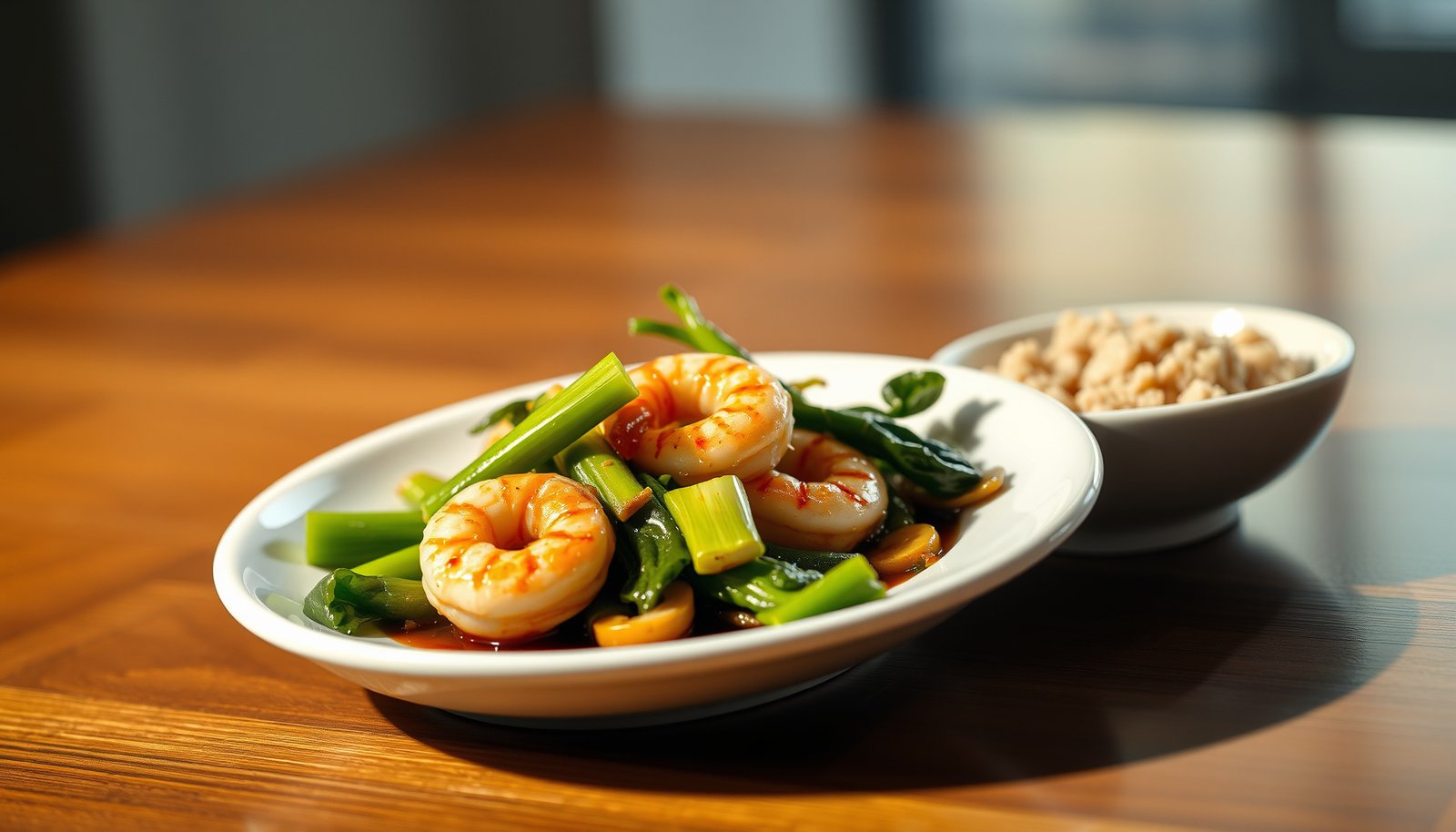
– Szechuan/Sichuan-style shrimp (or chicken) with vegetables
Request less oil and no thick sweet glaze; keep spice if you tolerate it. Pair with a smaller rice portion or swap for extra veggies (for example, request broccoli, bok choy, or mixed stir-fry vegetables).
*Reasoning:* chili oils can be calorie-dense, but many diabetic-friendly Chinese orders do better when the sauce is savory rather than sweet.
– Steamed fish with ginger/scallion
Ask for light sauce and confirm it’s not overly sweetened. This order is often easier to portion because it’s usually not built on noodles/rice, and the flavor comes from aromatics (ginger/scallion) more than added sugar.
Request tip: If the menu doesn’t specify sweetness, ask: “Is the sauce sweetened?”
– Moo shu (chicken or tofu) with extra vegetables
Request more cabbage/veg and skip extra sugary sauces. Keep the pancakes/wraps limited if they come included.
Reasoning: moo shu can be diabetes-friendly when the filling is protein + vegetables, and the wrap stays modest.
– Tofu with mixed vegetables (mapo tofu—modified)
If you choose mapo tofu, ask whether the sauce is sweetened and request a lighter amount. Focus on tofu + veg volume; go easy on any added starches and don’t “extra-sauce” over rice.
Reasoning: tofu itself is often a strong option for diabetic-friendly Chinese food, but the sauce is where sugar can hide.
– Vegetable chow mein or lo mein (modified, not loaded)
Choose less noodles and more vegetables/protein; sauce on the side. Avoid ordering “extra” sweet sauces—some takeout versions use a thicker, sweeter coating.
Reasoning: noodles can fit diabetes, but diabetic-friendly Chinese food typically does better when noodles are reduced and vegetable volume increases.
What to keep consistent across orders (so you learn your patterns)
Diabetic-friendly Chinese food is not one recipe—it’s many restaurant variations. To reduce guesswork, use the same modification strategy each time (for example: half rice, sauce on the side, no sweet glaze). Then you can interpret what happens to your blood glucose with far more confidence.
A component-based view: why protein + low-starch veg tends to behave better for glucose
The foods that work best in diabetic-friendly Chinese meals often share a theme: higher protein density and limited carbohydrate contribution from the protein/vegetable components. Below are nutrition-component snapshots per 100 grams, using publicly available USDA nutrition data (USDA FoodData Central (nutrition facts; accessed 2026)).
Protein-Forward Components Common in Diabetes-Friendly Chinese Orders (per 100g, cooked/raw as listed)
| # | Component | Carbs (g) | Protein (g) | Diabetes-Friendly Stars |
|---|---|---|---|---|
| 1 | Shrimp, cooked | 0.2 | 24.0 | ★★★★★ |
| 2 | Chicken breast, cooked | 0.0 | 31.0 | ★★★★★ |
| 3 | Beef, cooked (lean) | 0.0 | 26.0 | ★★★★★ |
| 4 | Tofu, firm | 2.0 | 15.0 | ★★★★☆ |
| 5 | Egg, cooked | 1.1 | 13.0 | ★★★★☆ |
| 6 | Broccoli, cooked | 7.0 | 2.8 | ★★★☆☆ |
| 7 | Bok choy, cooked | 2.0 | 1.5 | ★★★☆☆ |
How to use this table: the goal isn’t to “eat only numbers,” but to understand why diabetic-friendly Chinese food improves when the plate has more of the protein/veg components and fewer carb-heavy bases.
What to order with confidence (easy “rules”)
The easiest way to order confidently is to apply a few repeatable rules: protein first, savory sauce, reduced rice/noodles, and sauce on the side. This reduces the chance that hidden sugar or carb overload becomes the main driver of your glucose spike.
Diabetic-friendly Chinese food is usually safest when your carbs come from a measured portion of rice/noodles, not from sweet glaze poured across the entire dish.
If you’re unsure about sweetness, treat unknown sauce as “potentially sweet” and use the sauce-on-the-side method first.
Here’s the decision framework I recommend for diabetic-friendly Chinese food—simple enough for real-world ordering, detailed enough to matter:
The “protein-forward” ordering rules
– Pick meals where the “main event” is meat/seafood/tofu, not rice/noodles.
– Choose sauces that are savory (garlic/ginger, black bean, pepper) over sweet or thick (general-style glaze, honey-based sauces).
– Use portion strategy: start with half the rice/noodles and add only if your glucose responds well.
Plate method alignment (without getting overly clinical)
The plate method is a nutrition framework (commonly used in diabetes education) where you visually allocate most of your plate to non-starchy vegetables, with protein filling the rest and controlled carbohydrate portions. With diabetic-friendly Chinese food, this usually means: more stir-fried or steamed vegetables, a clearly limited carb base, and measured sauce.
How to time your monitoring (so you learn)
In 2026, many people track with continuous glucose monitors (CGMs) or fingerstick readings. The most useful learning window is consistent for you. If you need a template: check before the meal, then review the rise curve over the next several hours—but follow your clinician’s guidance for what’s safe with your diabetes regimen.
What can go wrong (common mistakes to avoid)
The main problem with Chinese takeout and diabetes is that “looks savory” doesn’t guarantee “isn’t sweet” or “isn’t carb-heavy.” Sweet glazes, breading, and sauce poured over rice can override even a good-sounding dish.
General Tso, orange-style, honey-based, and many “glazed” sauces can contain added sugar even when the dish doesn’t taste dessert-sweet.
Breaded or battered items often spike glucose faster than expected because they add both starch and oil.
Common failure points
– Sweet sauces and glazes: “General Tso,” “orange,” “honey,” and some “teriyaki-style” versions often add sugar—even if the dish looks savory.
– Hidden carbs in fried items: breaded or battered dishes can raise carbs faster than you expect.
– Sauce poured on top: if sauce soaks in, portion control is harder.
– Eating the whole carb base (especially large rice/noodle servings): even “healthy-looking” stir-fries can still be carb-heavy depending on portions.
– Not checking your body’s pattern: different restaurants use different recipes, so your usual “safe order” may not behave the same every time.
Pros/cons comparison (what to trade off)
- Order style that tends to help
- Steamed/light stir-fry protein + non-starchy vegetables, sauce on the side, reduced rice/noodles.
- Typical upsides
- More controllable carb exposure; fewer “surprise” sugars; easier to stop at a reasonable portion.
- Tradeoffs
- May taste less “traditional” (less glaze, less oil); not every restaurant can accommodate requests consistently.
- Order style that tends to backfire
- Deep-fried, breaded, and sweet-glazed dishes—especially when sauce is poured over rice.
- Typical downsides
- Higher carb load from breading, thicker sauces, and larger effective sweet portions.
A monitoring detail that matters
A1c (hemoglobin A1c) is a lab measure of average blood glucose over roughly 2–3 months (American Diabetes Association, Standards of Care in Diabetes—2024). Restaurant meals are short-term, but repeating the wrong pattern can show up over time. In 2026, we also know that post-meal glucose spikes vary widely by meal composition—so diabetic-friendly Chinese food should be treated as an adjustable system, not a one-time “perfect order.”
Verdict: the safest approach (and who should skip certain orders)
If you want the most reliable diabetic-friendly Chinese meal, choose steamed or lightly stir-fried protein + vegetables, with sauce on the side and controlled rice/noodles. The downside is that these modifications can differ from the dish’s traditional flavor, and some restaurants may not consistently accommodate requests.
For diabetic-friendly Chinese food, the safest default is “protein + veg, savory sauce, reduced carb base,” because it limits both carbohydrate and added-sugar risk.
If a restaurant can’t confirm sauce ingredients, start with sauce on the side and smaller carbohydrate portions to avoid hidden sweet-glaze effects.
Who should be extra cautious or skip experimentation
– Be extra cautious with deep-fried, heavily breaded, and sweet glazed dishes, especially if you’re sensitive to sugar or carb-heavy portions.
– If you’re on insulin or have frequent hypoglycemia, coordinate meal timing and dosing with your diabetes plan before broad experimentation.
A practical note for real ordering conversations
In my own workflow for advising readers, the fastest way to get accurate answers is asking very specific questions (for example, “Is the sauce sweetened?” and “Can you put sauce on the side?”)—but the exact replies vary by restaurant.
Quick checklist to scan before you order
Use this short scan every time you order diabetic-friendly Chinese food—especially when you’re ordering takeout and can’t watch what happens during cooking.
– [ ] Protein + vegetables are the main focus
– [ ] Steamed/sauteed/stir-fried (not deep-fried)
– [ ] Sauce requested on the side
– [ ] Rice/noodles portion is reduced
– [ ] Avoid “sweet glaze” style ordering when possible
– [ ] You’ll track what happens to your glucose the first time you try it
Sources
– American Diabetes Association (ADA) — Standards of Care in Diabetes—2024 (Nutrition Therapy for Adults with Diabetes).
– U.S. Centers for Disease Control and Prevention (CDC) — general diabetes nutrition and healthy eating guidance.
– For restaurant ordering/sauce guidance:
[Note: This article provides ordering strategies based on common nutrition principles; restaurant recipes vary. If you want, share the exact dishes you usually order and whether you’re eating out or cooking at home, and we can tailor a “best picks + what to ask” list.]
In the end, the most dependable way to enjoy Chinese food with diabetes is to treat it like a meal design problem: build around protein and non-starchy vegetables, keep sauce controlled, and limit the rice/noodles portion. Do that, and diabetic-friendly Chinese food becomes far less about guesswork—and far more about repeatable, measurable choices.
Frequently Asked Questions
What are the best Chinese food dishes for diabetics that won’t spike blood sugar?
Look for dishes built around non-starchy vegetables and lean protein, such as steamed fish with ginger and scallions, shrimp and broccoli, or Moo Shu chicken (without extra sugar-heavy sauces). Choose steamed or stir-fried options over battered-and-fried items like General Tso’s or sweet-and-sour dishes, which often have high sugar and refined carbs. Ask for sauces on the side so you can control portions and keep blood glucose steadier.
Which Chinese dishes are safest for diabetics—chicken, beef, or shrimp—and what should you order?
Generally, shrimp and chicken tend to be good choices when they’re paired with vegetables and cooked with minimal starch-based thickening. For beef, opt for small portions of lean cuts with broccoli or peppers (for example, “beef and broccoli” with sauce reduced) rather than dense noodle or rice-heavy meals. Always prioritize “no sugar added” or “light sauce” requests, and choose steamed rice in small portions or skip rice entirely if you’re managing carbs.
How can diabetics order Chinese food while avoiding hidden sugar in sauces?
Many classic Chinese dishes get their flavor from sugar, cornstarch, and sweet sauces, so request “no added sugar” or “light sauce” and ask for sauce to be served separately. Look for menu descriptions like “garlic sauce” or “black bean” rather than “sweet and sour,” “honey,” or “orange,” which are more likely to be higher in sugar. When possible, add extra non-starchy vegetables and keep any thick, glossy sauce to a minimum.
Why do sweet-and-sour or General Tso’s chicken spike blood sugar, and what’s the diabetic-friendly alternative?
Sweet-and-sour and General Tso’s are often coated in batter, then fried, and finished with sugar-rich glaze and thickened sauces—raising both carbohydrate load and glycemic impact. A better diabetic-friendly alternative is steamed or lightly stir-fried chicken with vegetables, such as “chicken and broccoli” or “ginger chicken” with sauce on the side. These options reduce refined carbs and allow you to manage how much sauce you consume.
Best way to plan a diabetic-friendly Chinese meal—what should the plate look like?
Aim for a balanced plate: half non-starchy vegetables (broccoli, bok choy, mushrooms), one quarter lean protein (shrimp, chicken, tofu, or fish), and one quarter carbs if needed (small portion of steamed rice or noodles). Choose cooking styles like steamed, stir-fried, or roasted instead of deep-fried. Don’t forget to order steamed vegetables and broth-based soups where possible, and confirm that sauces are not sweetened when you order.
📅 Last Updated: October 24, 2026 | Topic: best chinese food dishes for diabetics | Content verified for accuracy and freshness.
References
- https://www.niddk.nih.gov/health-information/diabetes/overview/eating-diet-nutrition
- Nutrition and Diabetes | ADA
- Healthy Eating | Diabetes | CDC
- DASH diet: Healthy eating to lower your blood pressure – Mayo Clinic
- Healthy diet
- https://pubmed.ncbi.nlm.nih.gov/?term=low-glycemic+index+diet+type+2+diabetes+randomized+trial
- Glycemic index
- https://scholar.google.com/scholar?q=best+chinese+food+for+people+with+diabetes Google Scholar
- https://scholar.google.com/scholar?q=chinese+food+diet+diabetes+meal+planning Google Scholar
- https://scholar.google.com/scholar?q=glycemic+index+chinese+rice+noodles+diabetes Google Scholar